
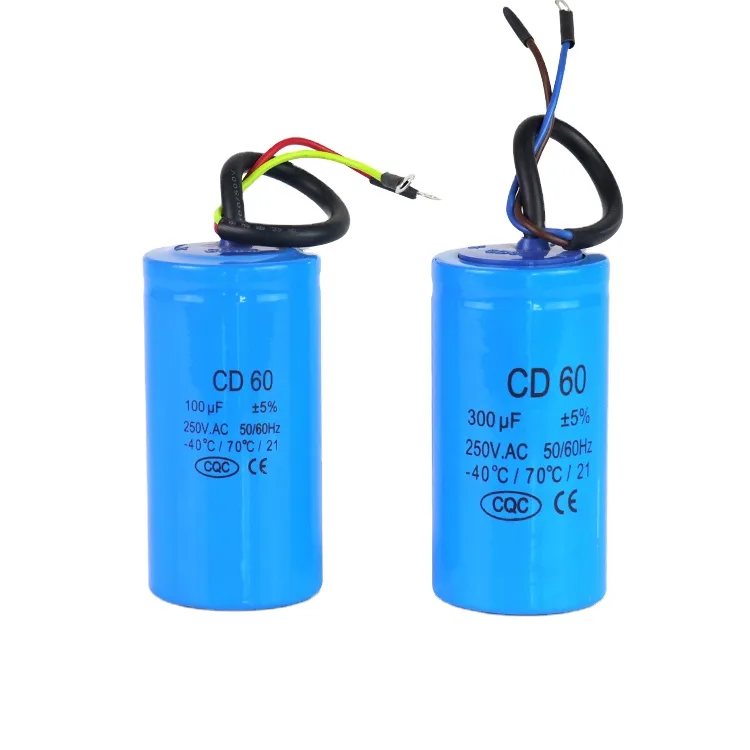
Every single-phase motor needs a phase shift to produce torque, but the capacitor that provides it during motor start is a fundamentally different animal from the one that stays in circuit while the motor runs. Mixing them up is one of the most common causes of field failures in pumps, compressors, and HVAC fans. This article breaks down the electrical and duty-cycle differences between intermittent-duty CD60 start capacitors and continuous-duty CBB60, CBB61, and CBB65 run capacitors — using only verified specifications from SMILER's product data.
The Core Electrical Difference: Phase Shift vs. Reactive Support
A start capacitor's job is to create a large phase angle between the main and auxiliary windings for a few hundred milliseconds to a few seconds. That requires high capacitance — typically tens to hundreds of microfarads — so the starting current can be several times the running current. The CD60 series is built for exactly this: high-capacitance, short-duration bursts that generate the torque needed to overcome compressor or pump inertia.
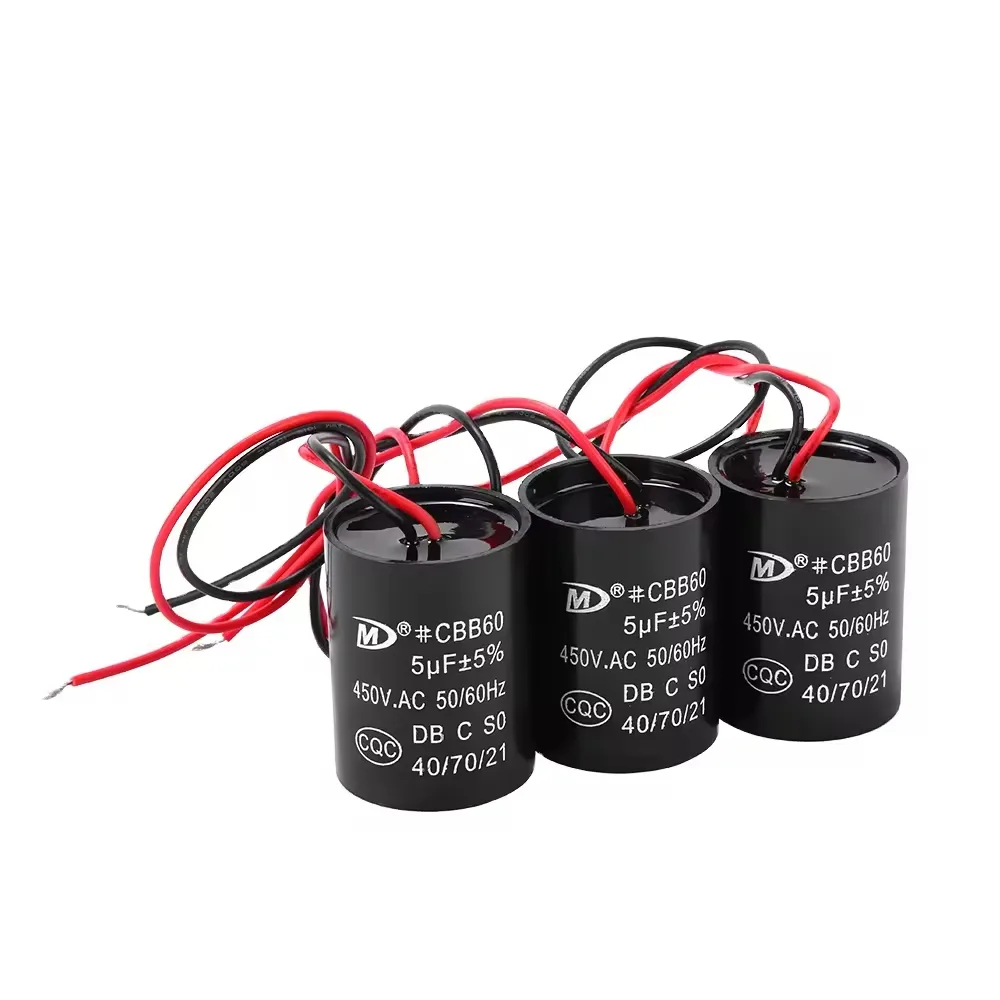
A run capacitor, by contrast, stays in the circuit continuously. It provides a smaller, steady phase shift that improves power factor, reduces line current, and smooths torque ripple during normal operation. The CBB60, CBB61, and CBB65 series use metallized polypropylene film with self-healing properties, designed for thousands of hours of continuous AC stress. Their dissipation factor is dramatically lower — tan δ ≤ 0.0020 for CBB60/CBB61 and ≤ 0.0025 for CBB65 — because even small losses become heat over 10,000 to 30,000 hours.
Put simply: the start capacitor is a sprinter, the run capacitor is a marathoner. You don't ask one to do the other's job.
Duty Cycle Defines the Design
The CD60 start capacitor is rated for intermittent duty. It's expected to be energized for seconds, then disconnected by a centrifugal switch or start relay. Continuous operation would overheat the dielectric and cause premature failure. SMILER's CD60 series is specified to IEC 60252-2 and GB/T 3667.2, the standards that govern AC motor start capacitors — a clear signal that the device is not intended for continuous run duty.
Run capacitors are built for continuous duty. The CBB60, CBB61, and CBB65 series carry life class ratings of A (30,000 hours), B (10,000 hours), or C (3,000 hours), depending on the model and application. That's a direct reflection of the continuous AC voltage stress they endure. The polypropylene dielectric and self-healing metallization are chosen to keep capacitance drift minimal over those hours.
Here's a practical rule: if the capacitor stays connected after the motor reaches speed, it must be a run capacitor. If it's switched out within a few seconds, it can be a start capacitor.
Specification Comparison: CD60 vs. CBB60/61/65
The table below summarizes the verified specifications for SMILER's motor start and motor run capacitor families. Note that capacitance and voltage ranges differ by series — don't assume a single blanket rating across all run types.
| Parameter | CD60 (Motor Start) | CBB60 (Run) | CBB61 (Run) | CBB65 (Run) |
|---|---|---|---|---|
| Primary function | High-torque phase shift during start | Continuous phase shift / power factor correction | Continuous phase shift for fans and small motors | Continuous phase shift for compressors and HVAC |
| Duty cycle | Intermittent (seconds) | Continuous | Continuous | Continuous |
| Capacitance range (SMILER series) | 1–120 µF (custom range); 50–400 µF per supplementary data | 1–80 µF | 0.4–50 µF | 3–100 µF |
| Voltage rating (SMILER series) | 450 V AC (primary); 110–450 V AC per supplementary data | 350–450 V AC | 450 V AC | 450 V AC |
| Dissipation factor (tan δ) | Not specified in SMILER data | ≤ 0.0020 | ≤ 0.0020 | ≤ 0.0025 |
| Life class | Not rated for continuous hours | A (30,000 h) / B (10,000 h) / C (3,000 h) | A / B / C per model | A / B / C per model |
| Climate category | -20 to +65 °C (per supplementary data) | 25/70/21 | Not specified in SMILER data | Not specified in SMILER data |
| Applicable standard | IEC 60252-2, GB/T 3667.2 | IEC 60252-2 (run types); CB/TUV/VDE/RoHS certified | CB CN65200; IEC 60252-2 (run types) | IEC 60252-2 (run types); explosion-proof P2 |
Note: The CD60 capacitance and voltage ranges above reflect both the primary product-series claim (1–120 µF, 450 V AC) and supplementary data (50–400 µF, 110–450 V AC). Always confirm the exact rating for your model with SMILER. Run capacitor life classes are model-dependent; not every CBB60/61/65 is class A.
When to Choose CD60 vs. CBB60/61/65
Choose a CD60 motor start capacitor when your application demands high starting torque — heavy-load compressors, air compressors, or pumps that must overcome significant inertia. The CD60's high capacitance provides the phase shift needed to generate that torque, and its intermittent-duty design keeps cost and size reasonable. Just make sure the start circuit disconnects it once the motor reaches speed.
Choose a CBB60, CBB61, or CBB65 run capacitor when the capacitor stays in circuit continuously. The CBB60 water pump capacitor is a common choice for pumps and washing machines, with 1–80 µF and 350–450 V AC ratings. The CBB61 suits fans and small motors (0.4–50 µF, 450 V AC). The CBB65 is the go-to for air conditioner compressors and HVAC, with 3–100 µF, 450 V AC, and an explosion-proof aluminum case (P2).
Many single-phase motors use both: a CD60 for start and a CBB65 for run. In that case, size the start capacitor for the torque you need and the run capacitor for the continuous reactive power. Don't try to substitute one for the other — the duty cycles and dielectric systems are incompatible.
Certifications and Quality You Can Verify
SMILER's motor run capacitors hold TUV Mark (R 50352497 0002, AC Motor Capacitor), VDE (40034278, Motor Running Capacitor), CB Scheme (CN36735 for AC Motor Capacitor; CN65200 for CBB61 Series), LVD (AN 50706408 0001), and RoHS (CANEC26003636901). The CD60 series is built to IEC 60252-2 and GB/T 3667.2. Note that certification scope varies by series — always check the specific certificate for your model. SMILER operates under ISO9001:2005 and has SGS on-site verification (report 489624232_P+T).
Manufacturing is backed by 9 automated production lines, 31 specialized machines, and a ≥99.93% finished-product qualification rate. A 7-member QA/QC team and in-house lab test every batch for DC withstand voltage, leakage, and other parameters. For OEM/ODM projects, SMILER offers custom capacitance, voltage, terminal configurations, and PPS high-humidity housings, with sample lead times as short as 5 days and average mass production in 15 days.
Explore the full motor capacitor product range to match the right series to your application.
Frequently Asked Questions
Can I use a CD60 start capacitor as a run capacitor?
No. CD60 capacitors are rated for intermittent duty only. Continuous operation would overheat the dielectric and cause early failure. Use a CBB60, CBB61, or CBB65 run capacitor for any circuit where the capacitor stays connected after the motor reaches speed.
What's the difference between CBB60, CBB61, and CBB65?
They're all motor run capacitors, but they differ in capacitance range, voltage rating, and construction. CBB60: 1–80 µF, 350–450 V AC, cylindrical PBT case. CBB61: 0.4–50 µF, 450 V AC, rectangular case for fans. CBB65: 3–100 µF, 450 V AC, explosion-proof aluminum case for compressors and HVAC. Choose based on your motor's capacitance and voltage requirements.
How do I know which capacitance value to use?
Always follow the motor manufacturer's specification. The run capacitor value is chosen to optimize power factor and torque at running speed; the start capacitor value is chosen for the required starting torque. Using the wrong value can cause overheating, low torque, or tripped overloads. If you're designing a new system, SMILER's engineering team can help you select the right series and rating.
Related Capacitor Series
Need Datasheets or Custom OEM Film Capacitors?
Send your capacitance, voltage rating, and mechanical drawing. Our 9-member engineering team replies within 24 hours with 5-day prototyping availability.