
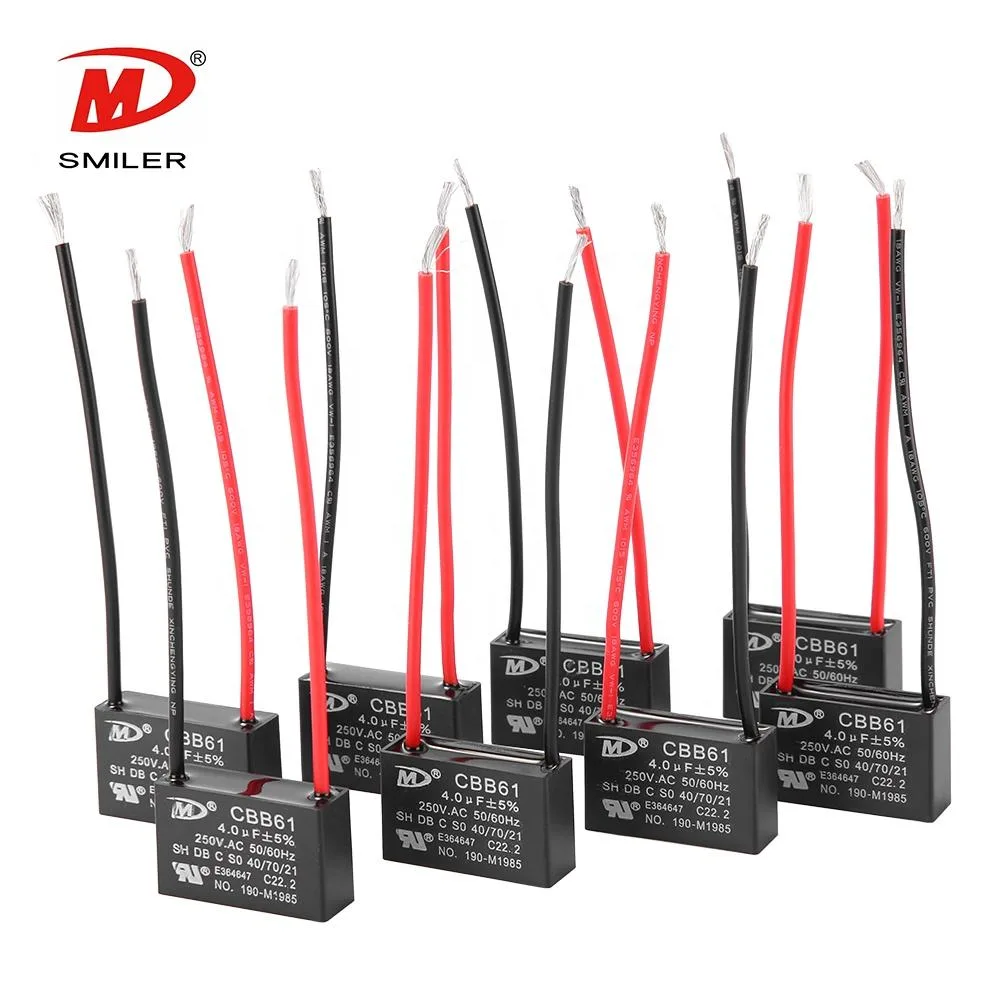
When you're specifying a run capacitor for a ceiling fan or an HVAC blower, the cbb61 rectangular can is probably already on your drawing. It's the default choice for single-phase fan motors across the appliance world, and for good reason: it's compact, self-healing, and cheap at volume. But the spec sheet hides a few decisions that will bite you later if you get them wrong. Voltage margin, life class, safety class, and termination style all interact with your motor design and your end market's regulatory regime. This guide walks through the practical choices an appliance OEM buyer faces when sourcing CBB61 capacitors, using only verified data from SMILER's published certifications and product lines.
What the CBB61 Actually Is (and Where It Fits)
The CBB61 is a metallized polypropylene film capacitor in a rectangular flame-retardant plastic case, available with wire leads or pin/spade terminals. It's designed for continuous AC operation as a motor run capacitor. In a ceiling fan, it shifts the phase of the auxiliary winding to create starting torque and keep the motor spinning smoothly. In an HVAC blower, it does the same job for the indoor fan motor. The rectangular form factor matters because it slots into tight control boxes where a round can won't fit.
SMILER's CBB61 line covers 450V AC as the standard rating, with the broader CBB family spanning 110V to 600V AC at 50/60Hz. Capacitance ranges from 0.4µF to 50µF, with common values like 0.5, 1, 1.5, 2, 2.5, 3, 3.5, 4, 5, 6, and 10µF stocked or easily tooled. Tolerance is ±5% (J) or ±10% (K). Dissipation factor is ≤0.0020. Those numbers look boring, and that's the point — a good run capacitor should be boring.
If you're comparing against the round CBB60 (1–80µF, 350–450V AC) or the aluminum-can CBB65 (3–100µF, 450V AC, with dual-run options), the CBB61 wins on board space and loses on raw capacitance ceiling. For most ceiling fans and small blowers, 50µF is plenty. For compressor start duty, you'd step up to a CD60 start capacitor, which SMILER lists at 50–400µF standard (1–120µF custom) at 110–450V AC.
Voltage Rating: Why 450V AC Is the Default
Your fan motor might run on 120V or 230V mains, so why specify a 450V AC capacitor? Because the capacitor sees more than line voltage. Back-EMF from the motor, switching transients, and harmonic content can push peak voltages well above nominal. A 450V AC rating gives you headroom without forcing a larger case. It's the industry-standard choice for a reason.
That said, the CBB line extends from 110V to 600V AC. If you're designing for a 100–120V market and space is brutally tight, a lower-voltage part could shrink the can. But don't go below 1.5× your worst-case RMS voltage, and remember that safety class (more on that below) may impose its own voltage derating. For 230V European or Asian markets, 450V AC is the sensible floor. For 277V commercial HVAC, consider stepping up within the CBB range.
Life Class and Safety Class: The Two Specs Buyers Overlook
Life class tells you how long the capacitor is expected to last under rated conditions. SMILER's CBB61 line offers three classes: A (30,000 hours), B (10,000 hours), and C (3,000 hours). A ceiling fan running 8 hours a day will accumulate about 2,900 hours a year. Class C would be marginal after 12 months. Class A gives you a decade of margin. For HVAC blowers that run continuously during cooling season, class A is almost mandatory if you want to avoid warranty claims.
Safety class is about failure mode. S0 through S3 classify how the capacitor behaves when it fails — whether it shorts, opens, or fails safely. Higher safety classes are required in some end-product standards and are always good practice in appliances that run unattended. The exact class you need depends on your end-product safety assessment, but don't default to the cheapest option. A failed run capacitor can take out a motor, and a motor replacement costs far more than the capacitor.
Terminations, Customization, and Volume Supply
CBB61 terminations come in two families: wire leads (often with a connector on the end) and pin or spade terminals for direct PCB or quick-disconnect mounting. Multi-value wire and pin configurations are available, which matters if your assembly line uses automated harnesses. Getting the termination right at the specification stage avoids a re-tooling charge later.
SMILER supports OEM/ODM customization on capacitance, voltage rating, case dimensions, terminal structure, and private-label marking. Sample lead time is as short as 5 days, and average mass production lead time is 15 days. Daily output runs about 300,000 units across 9 automated production lines, with a finished-product qualification rate of ≥99.93%. For an appliance OEM planning a seasonal build, that capacity and lead time matter as much as the electrical specs.
Specification Comparison: CBB61 vs. Related Motor Capacitors
| Parameter | CBB61 | CBB60 | CBB65 | CD60 |
|---|---|---|---|---|
| Typical application | Ceiling fans, exhaust fans, HVAC blowers | Pumps, washing machines, small compressors | AC compressors, HVAC fans | Motor starting (high torque) |
| Voltage range | 450V AC standard (CBB family 110–600V AC) | 350–450V AC | 450V AC | 110–450V AC |
| Capacitance range | 0.4–50µF | 1–80µF | 3–100µF (dual-run available) | 50–400µF standard (1–120µF custom) |
| Case style | Rectangular flame-retardant plastic | Round PBT/plastic | Aluminum can, explosion-proof | Aluminum can |
| Life classes | A (30,000h) / B (10,000h) / C (3,000h) | A / B / C | A / B / C | — |
| Safety classes | S0–S3 | S0–S3 | S0–S3 (P2 explosion-proof) | — |
| Dissipation factor | ≤0.0020 | ≤0.0020 | ≤0.0025 | — |
| Key certifications | CB CN65200, TUV, VDE, RoHS | CB, TUV, VDE, RoHS | CB, TUV, VDE, RoHS | IEC 60252-2 |
Certifications and Compliance: What to Ask Your Supplier
For ceiling fans and HVAC blowers sold into Europe, North America, and Asia, the CBB61 needs the right paperwork. SMILER holds CB Scheme certification for the CBB61 series under certificate CN65200, plus TUV Mark R 50352497 0002, VDE 40034278, LVD AN 50706408 0001, and RoHS CANEC26003636901. The broader CBB line also carries CB CN36735. The quality system is ISO9001:2005, verified through SGS report 489624232_P+T.
Ask for the certificate numbers and check they cover the exact capacitance and voltage you're buying. A CB certificate for a 450V AC 5µF part doesn't automatically cover a 600V AC 50µF variant. The same goes for RoHS — the certificate should list the product family and be current. SMILER's RoHS certificate is valid through June 2027, and the TUV Mark through June 2030.
If your end product needs IEC 61071 or IEC 60252-2 compliance, confirm that the capacitor's design and test data support it. The CBB61 is typically qualified under IEC 60252-2 for motor run capacitors, while IEC 61071 covers power electronic capacitors. Don't assume — ask.
Practical Selection Checklist for OEM Buyers
Here's a short checklist you can hand to your design team. First, confirm the motor's required run capacitance and tolerance — ±5% (J) is tighter and usually worth the small premium for blower motors where speed consistency matters. Second, pick the voltage rating with at least 1.5× margin over worst-case RMS, and default to 450V AC unless space forces otherwise. Third, choose life class A for continuous-duty blowers and class B for intermittent ceiling fan use; class C only for low-cost, short-life products. Fourth, select the safety class your end-product safety assessment requires, and don't go below S1 for unattended appliances. Fifth, lock in the termination style early — wire leads with connectors for harness assembly, pins for PCB mount. Sixth, verify certification coverage for the exact part number.
Finally, ask about supply continuity. A 300,000-unit daily capacity and 15-day average lead time give you room to ramp, but seasonal demand spikes can still strain any supplier. SMILER's 9 production lines and 5-day sample turnaround help here. You can review the full quality process at SMILER's quality page, and browse the CBB61 ceiling fan capacitor product page for detailed specs. For custom requirements, contact the engineering team directly.
Frequently Asked Questions
What is the difference between life class A, B, and C on a CBB61?
Life class indicates expected operating hours under rated conditions: class A is 30,000 hours, class B is 10,000 hours, and class C is 3,000 hours. For a ceiling fan running 8 hours a day, class A gives roughly a decade of service; class C would be marginal after about a year. Choose class A for continuous-duty HVAC blowers and class B for intermittent fan use.
Can I use a CBB61 capacitor in a 230V HVAC blower?
Yes. The standard 450V AC rating provides ample margin for 230V mains, accounting for back-EMF and transients. Just confirm the capacitance value matches your motor's requirement and that the safety class meets your end-product assessment. For 277V commercial systems, check the upper end of the CBB range (up to 600V AC) or consult the supplier.
What certifications should I verify for a CBB61 fan capacitor?
Look for CB Scheme certification (SMILER's CBB61 series is covered under CN65200), TUV Mark (R 50352497 0002), VDE (40034278), LVD (AN 50706408 0001), and RoHS (CANEC26003636901). Also confirm the supplier operates under a certified quality management system such as ISO9001:2005. Always check that the certificate explicitly covers the capacitance and voltage you're ordering.
Related Capacitor Series
Need Datasheets or Custom OEM Film Capacitors?
Send your capacitance, voltage rating, and mechanical drawing. Our 9-member engineering team replies within 24 hours with 5-day prototyping availability.