
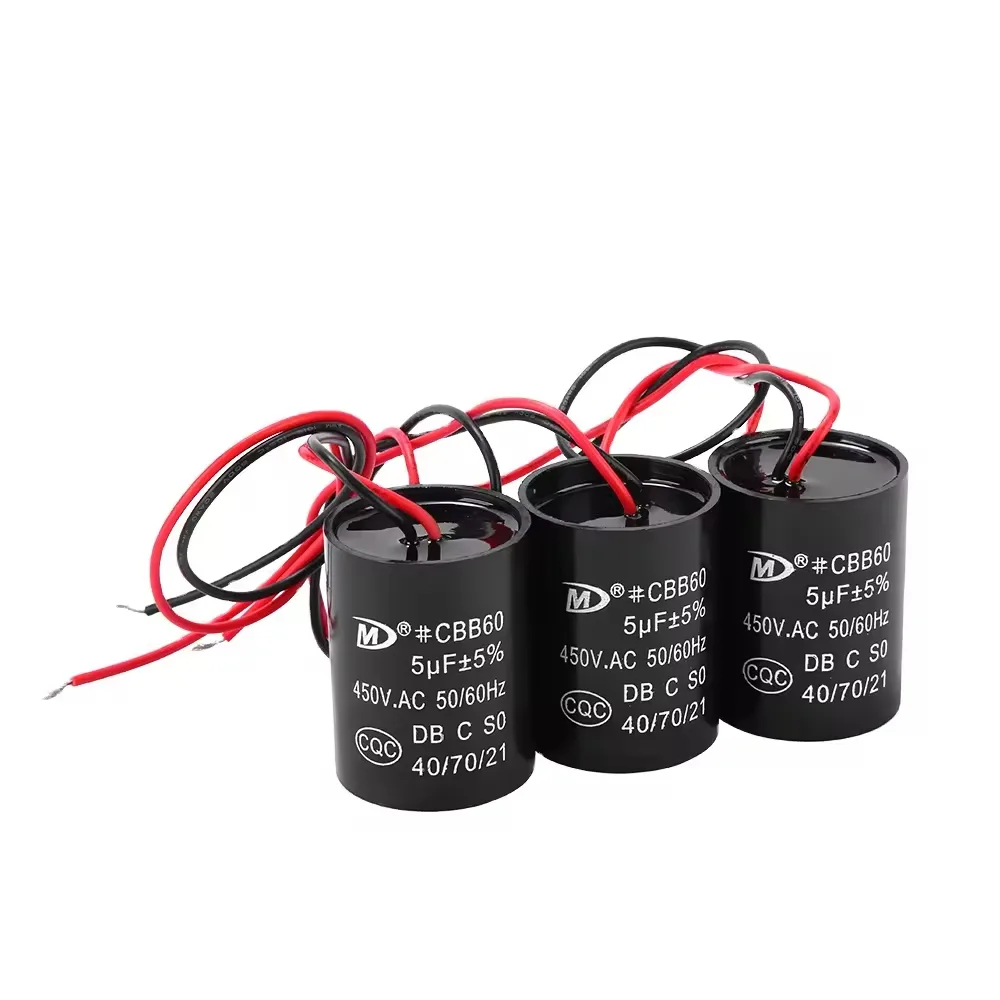
Choosing between a CBB60 and a CBB65 capacitor isn't just a size decision. The cbb60 vs cbb65 comparison comes down to construction, thermal path, and fault behavior. One is a PBT plastic cylinder for water pumps and washers. The other is an explosion-proof aluminum can for air conditioner compressors. Get the selection wrong and you'll trade a few cents for a field failure. This article walks through the engineering differences that matter, from thermal dissipation and fault disconnection to life classes and the certifications you should demand from your supplier.
Construction: PBT Plastic vs Explosion-Proof Aluminum
The CBB60 uses a PBT flame-retardant plastic cylindrical case with a dry, self-healing metallized polypropylene element. Terminals are double spade or lead wire. Capacitance runs from 1µF to 80µF at 350V–450V AC, 50/60Hz, with a climate category of 25/70/21. It's a light, cost-effective package for general single-phase AC motors.
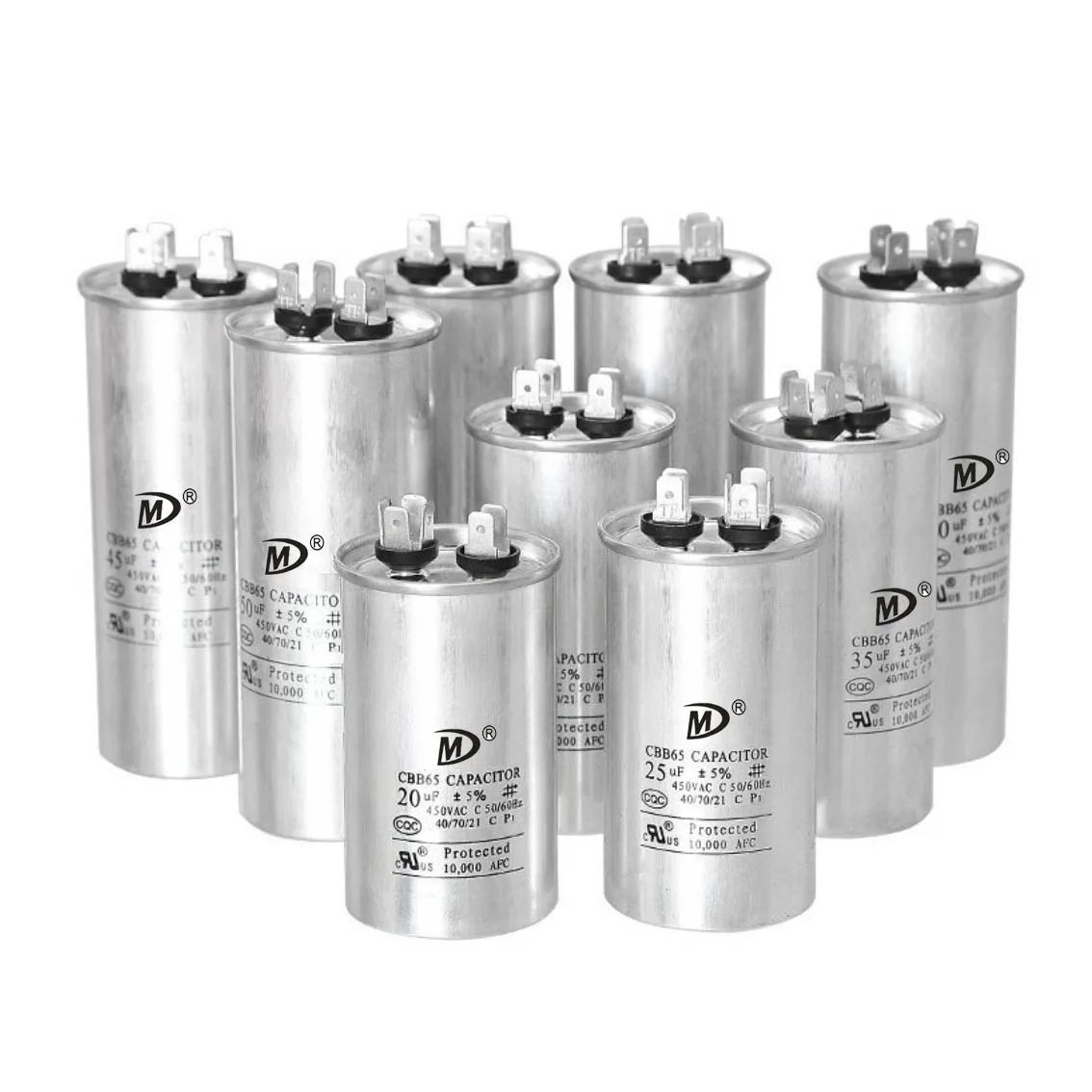
The CBB65 takes a different path. It's built into an explosion-proof P2 aluminum can, oil-filled, with single or dual-run capacitance from 3µF to 100µF at 450V AC. Common dual-run values like 35+5µF let one can serve both the compressor and the condenser fan. That aluminum shell isn't cosmetic. It's a pressure vessel designed to vent safely when the element fails.
If you're specifying a water pump or washing machine, the CBB60 water pump capacitor is the natural fit. For compressor duty, the CBB65 HVAC compressor capacitor is the one you want. The construction difference drives everything else.
Thermal Dissipation: Why the Can Matters
Heat is the enemy of film capacitors. Every AC motor run capacitor carries ripple current, and that current generates I²R losses inside the element. How fast those losses escape determines life.
A PBT plastic case is a decent insulator, but it's a poor thermal conductor. Heat has to travel through the plastic wall to ambient air. In a cool, ventilated water pump enclosure, that's fine. In a sealed compressor compartment at 70°C ambient, it's a problem. The CBB65's aluminum can conducts heat far better. The oil fill also helps move heat from the element to the can wall. That's why CBB65 capacitors tolerate the higher ripple currents and ambient temperatures found in HVAC service.
Say a 100kW string inverter uses DC-link capacitors with a defined thermal path. The same logic applies at a smaller scale to motor run capacitors. If your compressor compartment runs hot, the aluminum can gives you margin the plastic case can't.
Fault Disconnection and Safety Class
When a metallized film capacitor fails, it can fail short. The element overheats, the impregnant vaporizes, and pressure builds. What happens next separates a safe design from a liability.
The CBB65's P2 explosion-proof construction includes a pressure-sensitive disconnection mechanism. As internal pressure rises, the top cover deforms and breaks the internal connection before the can ruptures. That's the S0–S3 safety class system in action, with P2 being the explosion-proof variant. The CBB60, being a dry plastic-case design, relies on self-healing and its own fault behavior. It's appropriate for its application class, but it isn't a pressure-vessel design.
For compressor duty, don't compromise on the P2 can. A shorted compressor run capacitor in a sealed system can be expensive to diagnose and replace. The disconnection mechanism is cheap insurance.
Life Classes A, B, and C: What the Numbers Mean
Both CBB60 and CBB65 are available in life classes A, B, and C. The class defines expected operating life under rated conditions:
| Parameter | CBB60 | CBB65 |
|---|---|---|
| Case | PBT flame-retardant plastic cylinder | Explosion-proof P2 aluminum can, oil-filled |
| Capacitance range | 1µF – 80µF | 3µF – 100µF (dual-run e.g. 35+5µF) |
| Rated voltage | 350V – 450V AC, 50/60Hz | 450V AC, 50/60Hz |
| Climate category | 25/70/21 | Per series datasheet |
| Dissipation factor | tg δ ≤ 0.0020 | tg δ ≤ 0.0025 |
| Life class | A (30,000h) / B (10,000h) / C (3,000h) | A (30,000h) / B (10,000h) / C (3,000h) |
| Safety class | S0–S3 | S0–S3, explosion-proof P2 |
| Typical applications | Water pumps, washers, small compressors, general AC motors | AC compressors, HVAC fans, industrial refrigeration |
| Certifications | CB, TUV, VDE, RoHS | TUV, VDE, CB, RoHS |
Class A at 30,000 hours is the long-life choice. Class B at 10,000 hours suits standard appliance duty. Class C at 3,000 hours is for intermittent or low-cost applications. Match the class to the duty cycle, not to the price sheet. A compressor that runs eight hours a day needs Class A or B. A washer that runs an hour a day can live with Class C.
Certifications: What to Verify Before You Buy
Both series should carry the certifications that matter for your market. SMILER holds TUV Mark R 50352497 0002 for AC motor capacitors, VDE 40034278 for motor running capacitors, CB Scheme CN36735 and CN65200, LVD AN 50706408 0001, and RoHS CANEC26003636901. The quality system is ISO9001:2005, verified through SGS report 489624232_P+T.
These aren't just logos on a datasheet. TUV and VDE certification means the construction, creepage distances, and fault behavior have been independently tested. CB Scheme certificates ease acceptance in multiple countries. If your HVAC OEM customer asks for proof, you'll want a supplier who can produce the certificate numbers.
SMILER's CBB65 and CBB60 lines are produced on 9 automated lines with a daily capacity of about 300,000 units and a finished-product qualification rate of ≥99.93%. The 7-member QA/QC team runs DC withstand voltage testing, leak testing, and in-house lab checks on every batch. That's the kind of process control that keeps field returns low.
Selection Guidance for HVAC and Pump Applications
Start with the application. Water pumps, washing machines, and general single-phase motors get the CBB60. Its 1–80µF range, 350–450V AC rating, and compact plastic case fit the enclosure and the duty cycle. Air conditioner compressors, HVAC fans, and industrial refrigeration get the CBB65. The explosion-proof aluminum can, oil fill, and dual-run options make it the right tool for sealed, hot, high-ripple environments.
Then check the life class against the duty cycle. Then verify the certifications for your destination market. If you need custom capacitance, terminal configurations, or OEM marking, SMILER supports OEM/ODM with a 5-day sample lead time and average 15-day mass production lead time. You can review the full range on the applications page.
Don't substitute a plastic-case capacitor into a compressor circuit to save cost. The thermal path and fault disconnection aren't there. And don't over-specify an aluminum can for a cool pump enclosure if the budget is tight. Match the construction to the job.
Frequently Asked Questions
Can I use a CBB60 in place of a CBB65?
Only if the application matches. The CBB60 is a dry plastic-case capacitor for pumps and general motors. The CBB65's explosion-proof aluminum can and oil fill are designed for compressor duty, where ripple current and ambient temperature are higher. Substituting a CBB60 into a compressor circuit removes the pressure disconnection safety mechanism and shortens thermal margin. Don't do it.
What does the P2 marking on a CBB65 mean?
P2 indicates explosion-proof construction. The aluminum can includes a pressure-sensitive disconnection mechanism that breaks the internal circuit before the can ruptures under fault conditions. It's part of the S0–S3 safety class system. For compressor applications, P2 construction is the baseline expectation.
Which life class should I specify for an air conditioner compressor?
Class A (30,000 hours) or Class B (10,000 hours) for continuous or daily compressor duty. Class C (3,000 hours) suits intermittent use. Match the class to the actual run hours and the warranty you're offering. A higher class costs more upfront but reduces field failures and warranty claims.
Related Capacitor Series
Need Datasheets or Custom OEM Film Capacitors?
Send your capacitance, voltage rating, and mechanical drawing. Our 9-member engineering team replies within 24 hours with 5-day prototyping availability.